
How Much Screen Time Is Okay for a 2 to 4 Year Old? An Honest Answer

It’s 6:40 in the evening. Rice is on, the ulam is half done, and a two-year-old has decided your leg is a climbing frame. So the tablet comes out. The theme song starts. You get eleven quiet minutes, and a small voice at the back of your head says you’ve just done something bad.
That voice is why most advice about screen time for toddlers lands so badly here. It assumes a spare adult at 6:40pm and a living room where the TV isn’t three steps from the dining table. Your house has both parents working, a yaya who genuinely has to cook, and a child who has learned that food tastes better with a screen in front of it.
Here’s the honest version, minus the sermon.
The Number You Came Here For
The guidance quoted almost everywhere runs like this. Under 18 months, skip screens apart from video calls with lolo and lola, which have never counted against the limit because somebody is talking to your child and waiting for an answer. From two to five, aim for about an hour a day of decent content, with an adult nearby who talks about what’s happening.
So: about an hour.
Hardly any family hits that. If your three-year-old lands closer to two hours on a Tuesday, you have not damaged him. You’re where plenty of Quezon City households sit, and the gap between one hour and two matters far less than what those hours are made of.
Screen Time for Toddlers Is Not One Thing
Two children can both watch ninety minutes a day and be having completely different childhoods.
The question isn’t how long. It’s what the screen took the place of. Ninety minutes while you cook costs your child very little, because the alternative was a toddler orbiting your knees in a hot kitchen. Ninety minutes that swallowed the tower-building and the same board book for the ninth time is a different transaction.
Small children learn language through back and forth. You say something, they answer with a sound or a very confident sentence about a dog, you answer that. A tablet never waits for a reply. So the fix usually isn’t “cut an hour”. It’s “protect the twenty minutes that were doing the work”.
Why Some Shows Are Harder Than Others
Watch what your child watches for five minutes. Time the cuts.
Plenty of what autoplays changes shot every two seconds, colours at maximum, music that never stops. It’s built to hold attention, not to be understood, and a toddler comes out of it more wound up than he went in.
A slower programme, where somebody speaks in full sentences and lets a scene breathe, does something else. The pauses are the point. That’s where a two-year-old processes the word he just heard, and where you get room to say “oh look, he’s sad” and have him check your face. Talking to him while he watches turns it into language practice. Ten minutes counts.
Switching off autoplay takes two seconds and is the highest-value change here. It’s the difference between one episode and four.
The TV Nobody Is Watching
The teleserye running through dinner. The vlog on somebody’s phone on the sofa. Nobody’s really watching, so it feels free.
It isn’t. Background television is the quiet one, because of what it does to the adults. With a screen on in the room, grown-ups start fewer conversations with the child and answer more briefly when he starts one. Your toddler’s vocabulary is built out of those exchanges.
Off at meals. Off during play unless somebody is genuinely watching it.
The Tablet at the Table
Lots of families have a child who only finishes a plate while watching something. It started in a week when he refused everything and somebody was desperate. It worked. Now it’s the rule.
A child watching a screen isn’t tasting much. He’s on autopilot, missing the signals that tell him he’s full, and at three or four he won’t touch anything unfamiliar, because he’s never really looked at what was on the spoon.
Don’t go cold turkey. That’s a war you’ll lose by Wednesday. Move in steps over two or three weeks: the screen shifts from in front of him to the side of the table, then audio only, then on after the first few bites, then only once the plate is cleared. He’ll eat less for a few days. That passes.
Two Fences Instead of Twenty Rules
Most rules about screen time for toddlers ask you to police the whole day. That will exhaust you. Pick the two windows that genuinely cost you something and defend only those.
- The hour before sleep. Bright light and a wound-up brain make bedtime longer and night waking likelier. Stopping before bath and books buys the evening back.
- Mealtimes. For the eating reasons above, and because the table is one of the few places the family still talks.
- No devices in the bedroom. Nothing on the bed, no phone charging where he sleeps.
- End by episode, not by minutes. “Five more minutes” means nothing to a three-year-old, who has no sense of what five minutes is. “One more Peppa, then it’s off” is a boundary he can see coming. A sand timer works too.
- Name what comes next before you switch it off. “When this finishes, we’re getting the blocks out.” A child who knows what’s arriving protests less than one who only knows what’s leaving.
Then run a test. Swap one screen slot a day for something physical and hold it two weeks. Walk to the sari-sari store. Dance in the living room. Most parents find the asking fades by week two, which tells you the habit was about the slot more than the screen.
Why He Melts Down When It Goes Off
You take the tablet and he screams like something’s been amputated. Easy to read that as defiance. It’s usually not.
A two-year-old hasn’t built the machinery for switching tasks yet. The part of the brain that stops something he loves so he can start something else is one of the last to mature, which is also why he can’t leave the playground and can’t accept that the biscuit is finished. Screens are engineered to be hard to leave, so they make it worse.
That’s why the warning and the named next activity help. You’re doing the switching for him, out loud, until he can manage it himself.
Want to talk it through?
If you’re weighing up a play class and want to ask about ages or what a day looks like, call or message us.
📞 0966-401-6118
📞 0956-268-2674
What Actually Competes With a Screen
A screen doesn’t lose to a rule. It loses to a better offer.
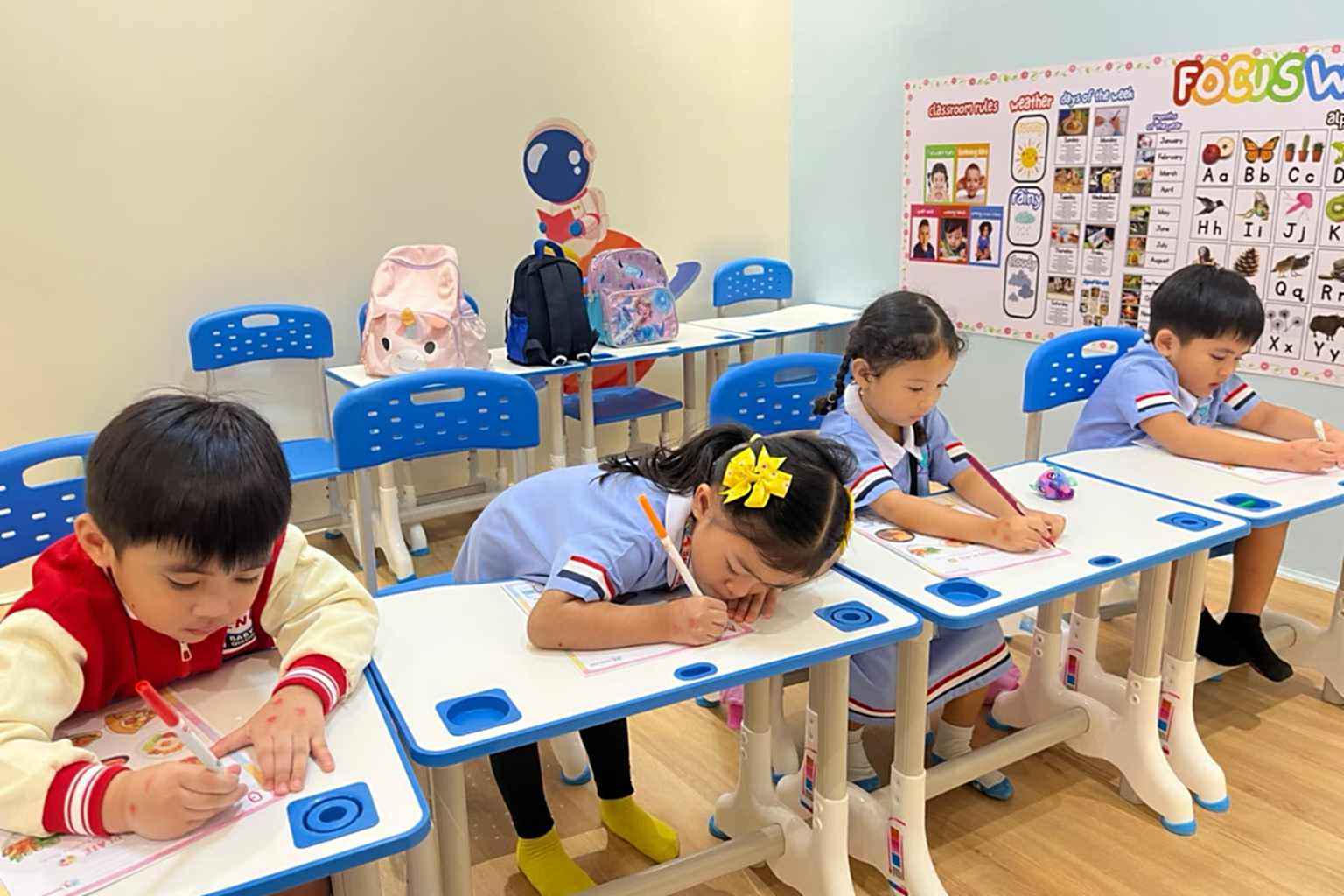
A day with enough movement, other children to negotiate with, and something messy for his hands leaves a toddler with less appetite for the tablet and less energy to argue about it. That’s the shape of our Premium Play School Program for ages 1.8 to 4 in Quezon City: guided play, dancing, circle time, art and craft, painting, inside a monthly theme across ten months. Parents tell us the same thing often enough to repeat it. A child who’s had a full, active morning asks for the screen less by afternoon.
If you’re curious what fills those hours, we’ve written about what a toddler learns in a day of play school, and about how play-based learning differs from a traditional preschool. Both campuses are listed on the services page.
Questions Parents Actually Ask
Is educational content on YouTube fine?
Some is genuinely good, some is nonsense in an alphabet costume. Judge it by pace and speech, not by the label. A real person talking in real sentences, with shots that last longer than a blink, is usually fine.
My toddler is on two hours a day. Have I ruined him?
No. Look at what those two hours replaced. If he’s still getting floor play with an adult and time outside with other kids, two hours won’t be the thing that shapes him. If the screen has quietly eaten all of that, reclaim one slot rather than the whole two.
How do I get the yaya on board?
Give her something concrete instead of a rule about hours. Autoplay off, TV off at meals, one named afternoon slot for something physical. Written on the fridge. A clear boundary is easier to follow than a vague instruction to limit screens.
The Short Version
An hour a day is the target for a two-to-four-year-old, you probably won’t hit it, and that’s survivable. What decides the outcome is whether the screen fills the gaps in your day or eats the good parts. Protect bedtime and the dinner table, kill autoplay, and sit beside him for some of it so watching turns into talking.
Then give him a day busy enough that he forgets to ask. If you’d like to see that in a real classroom, come and visit one of our campuses and watch an hour of guided play for yourself.