Buwan ng Wika: Is It Okay to Teach Toddlers Filipino and English at the Same Time?

The Buwan ng Wika program at the big school down the road is next week, and somewhere between the costume and the Tagalog poem, you catch yourself doing quiet math on your own two-year-old. He says “milk” and “bye” and “ate.” He also says “aso” and “ayaw ko.” Mostly he says something in between that only you and the yaya can decode. So the worry shows up right on schedule: is teaching toddlers Filipino and English at the same time actually helping him, or will he end up half-good at both and mahina sa English at big school?
He’s fine. Really. The longer answer is still worth ten minutes, because the one thing that usually goes sideways is fixable tonight.
The Household Your Toddler Actually Lives In
Picture the ordinary Quezon City setup. You and your husband speak Taglish, sliding between languages mid-sentence without noticing you did it. Lola speaks straight Tagalog, or Ilocano if she came from up north. The yaya speaks Bisaya on the phone to her sister and a soft mix of both to your child. The tablet speaks confident American English about dinosaurs. That isn’t chaos. More than half the children on this planet grow up hearing two languages or more at home, and they learn to talk on roughly the same schedule as everyone else.
Two Languages Don’t Confuse a Toddler. They Take Up Room.
Babies sort languages by sound and rhythm long before they say a word. By the time your toddler is putting two words together, he already knows that what lola does with her mouth is a different system from what the tablet does. The fear behind teaching toddlers Filipino and English at once is that the two will scramble each other in his head. They don’t.
What looks like confusion is plainer than that. He has one word for a thing, and today it’s the Tagalog one. He says “tubig” because tubig arrives with the cup and with the person handing it over.
Why Teaching Toddlers Filipino and English Can Look Slow on Paper
Here’s the honest part, and the part milestone charts skip. Bilingual toddlers often hit some language markers on a slightly different timetable than a child who hears one language all day. Fewer English words at eighteen months than the cousin raised in English only. A little longer to sort out grammar in both. It evens out.
The real mistake is counting one column. Speech-language specialists assessing a bilingual toddler count words across both languages together, because that’s how the child’s vocabulary works. Forty words in Tagalog and thirty in English means seventy words, not thirty. If you’ve been quietly counting and coming up short, it helps to see what a toddler’s language looks like across an ordinary day in a play school program before you decide something is wrong.
Every Tita Code-Switches and Nobody Calls It a Deficit
“Pakiabot nga yung water, please.” You’ve said something like it this week. So has your boss, your OB, the guy on the radio. Mixing two languages inside one sentence is called code-switching, and it takes more skill rather than less. You need both grammars well enough to splice them without breaking either.
Toddlers do it for a simpler reason. They use the word they have. If “gatas” is loaded and “milk” isn’t yet, “I want gatas” is a sensible sentence from a small person working with the parts in the box. Correcting him mid-sentence teaches him that talking to you is risky. Answer him first. Then say the whole thing back in one language, casually.
The Quiet Weeks Nobody Warns You About
Some children go silent when a second language suddenly gets loud in their life. It shows up most often when a child who has heard mostly Tagalog at home starts a class run mainly in English. He chatters at home. At school he watches, listens, and says close to nothing for weeks.
This is the silent period, and for plenty of children it’s ordinary. He’s collecting. Sound patterns, stock phrases, what people say when the snack comes out. Then it surfaces in whole chunks rather than single words, and one Tuesday you get a full sentence out of nowhere. Warm adults who don’t put him on the spot make it shorter. Pressure makes it longer.
One Person, One Language Beats One Rule for Everybody
If you take one practical thing from this, take this one. What helps a bilingual toddler is consistency of source rather than consistency of rule. Each person, or each setting, reliably brings the same language, so the child gets a clean signal instead of a blur. Lola speaks Tagalog to him even when he answers her in English. The yaya uses whichever language is genuinely hers. Bedtime stories are in English, same chair every night. You don’t have to police yourself all day.
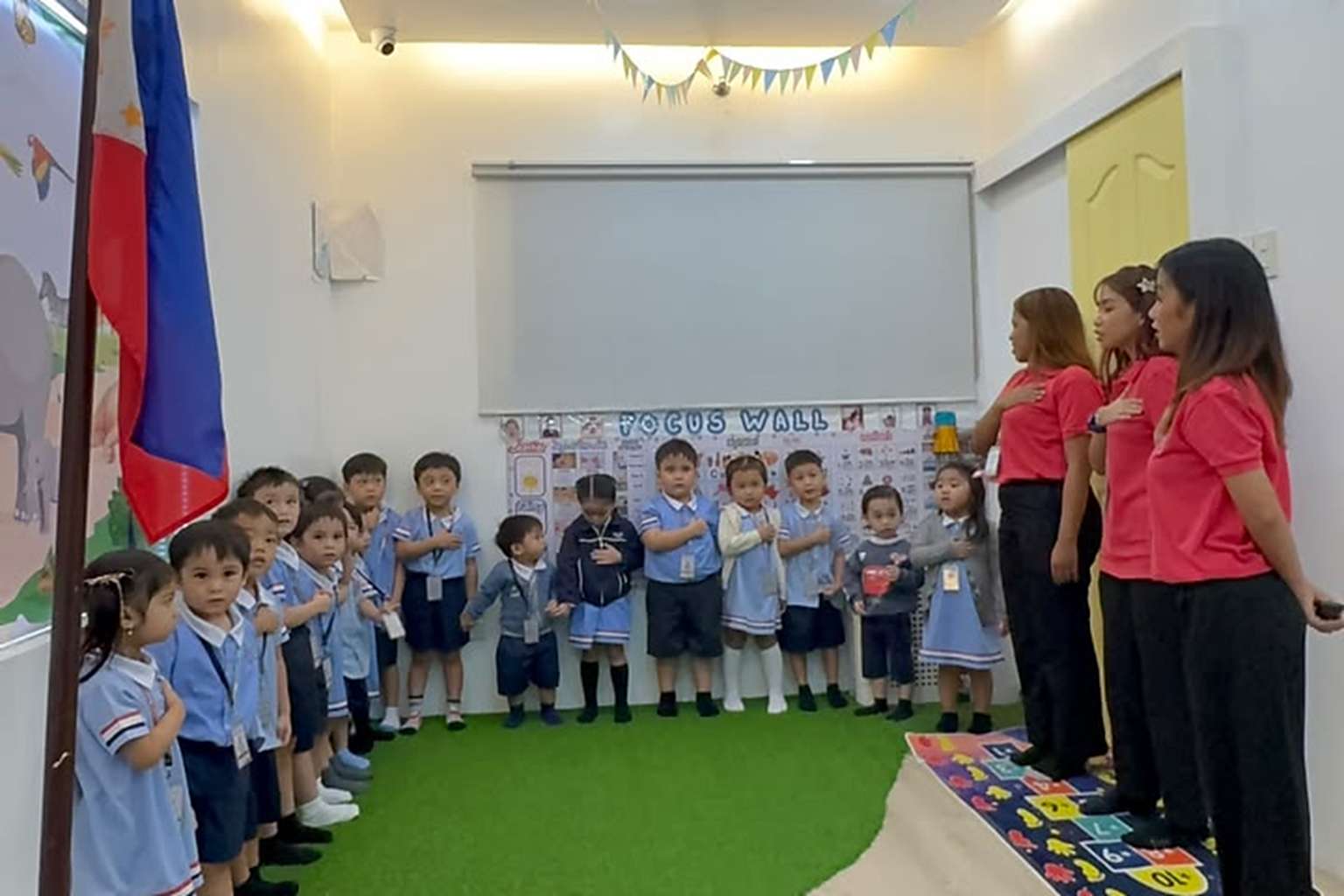
School is one of the cleanest signals a child gets, because it repeats on purpose. In our Premium Play School Program, language and literacy runs as its own strand inside a monthly thematic curriculum, so a word a child meets at circle time turns up again during art, during eating time, at the flag ceremony. Circle time and storytelling are where both languages surface most naturally, and where a child still quiet in one of them can listen his way in without anyone staring.
Dropping Filipino to Boost English Usually Backfires
Plenty of loving parents make this trade. They stop speaking Tagalog at home and flip the household to English, hoping the child arrives at big school ahead of the pack. Two things tend to happen instead.
The first is family. A child who loses Filipino loses lola and lolo with him, or at least the deep part of them: the stories, the way an older Filipino tells you they love you without ever saying the words. Parents regret that one out loud, years later.
Literacy is the other half. A strong first language props up the second. A child with a big store of words, who knows how stories go and how sounds come apart in the language he owns, carries all of it across when he starts reading. If you’re watching for the moment letters and sounds click, here’s what reading readiness really looks like in a preschooler.
Buwan ng Wika at Home, Without the Costume
August is a good excuse, and none of this costs much.
- Sing the awit you already know. “Bahay Kubo,” “Leron Leron Sinta,” “Ako ay May Lobo.” Rhymes carry vocabulary and rhythm in a package he’ll ask for again.
- Name things at the palengke. Talong, kamatis, bangus, sitaw. Hand him one. Let him hold it while you say the word.
- Cook out loud. Hinuhugasan ko ang bigas. Kumukulo na ang sabaw. Kitchen commentary is free language input.
- Read one Filipino picture book a week. Adarna and Lampara titles turn up in most Quezon City bookstores and at book fairs.
- Let him order his own merienda. “Isang taho po.” At the sari-sari store, with you standing right behind him.
Whatever you pick, repeat it. A rhyme sung forty times does more for him than forty different worksheets.
Want to talk it through with a teacher who sees this every August?
We’re in West Fairview and along Commonwealth Avenue, and we’re glad to answer language questions even if you’re only asking. Call or text us.
📞 0966-401-6118
📞 0956-268-2674
What’s Actually Worth Checking, in Any Language
Bilingualism doesn’t cause speech delay, which means it can’t be the explanation when something genuinely is off. Real concerns look the same in Tagalog, English or Bisaya, and they’re about the whole picture across every language your child hears.
By around two, most children are combining two words in some language. By around three, most of the family can understand the bulk of what they say. Watch also for a child who doesn’t turn to his name, doesn’t point at things to show you, or has quietly lost words he used to have. Those are worth raising with your paediatrician, who can refer you to a speech-language pathologist. Ask for someone comfortable assessing bilingual children, and bring examples from both languages.
Nobody should be telling you the fix is to drop a language. It isn’t.
Questions Parents Ask Us Every August
He answers me in English when I speak Tagalog. Is he rejecting it?
He’s picking whichever language gets the fastest, happiest response, usually the one he hears most. Keep speaking Tagalog to him anyway. Understanding runs well ahead of speaking, and children often switch back once the language earns its keep, like after a summer with lola in the province.
Is the yaya’s Bisaya a problem?
It’s a gift, as long as she speaks it comfortably. A third language from someone who loves your child beats another hour of screen English. What you want to avoid is asking her to use a language she isn’t fluent in, because then he hears a broken model all day.
What if we want structure but can’t commit to a whole school year?
Most children settle into a group setting somewhere between 1.8 and 4 years old, and a shorter run is a fair way to test it. Our eight-week Enrichment Program in Quezon City covers storytelling, reading sessions and group play in two short batches.
The Short Version
Teaching toddlers Filipino and English side by side doesn’t confuse them and doesn’t set them back in any way that lasts. Count his words across both languages, not one. Let him mix. Give him a few people whose language never changes, and let lola talk to him however she likes. Then sing “Bahay Kubo” until you’re thoroughly sick of it, because that’s what Buwan ng Wika is for in a house with a two-year-old in it.