“One More Story!” How to Read Aloud to a Toddler Who Won’t Sit Still

You picked a lovely book. You sat down, opened it, read the first line in your best storytelling voice, and your toddler climbed off your lap, turned three pages at once, pointed at a dog, and left to find a ball. Welcome to reading aloud to toddlers.
If that sounds like your reading time, you are not doing it wrong, and your child is not “not a reader.” You are reading to a toddler. Sitting still and listening to a whole story from start to finish is a skill that develops slowly, usually somewhere between three and four. Before that, reading aloud looks very different, and it still works.
November is National Reading Month in Philippine schools, so this is a good time to look at how reading aloud actually works with children between one and three, and how to make it something you both look forward to.
Why Reading Aloud to Toddlers Matters So Early
Reading to a toddler isn’t about teaching them to read. That comes much later. It is about language.
Books use words that rarely come up in daily conversation. In a normal day at home, you might say “eat,” “sleep,” “bath,” and “no” many times over. In a picture book, a child meets words like “gigantic,” “whisper,” “tumble” and “lighthouse.” The more words a child hears in a warm, relaxed setting, the more they understand, and understanding comes before speaking.
Reading aloud also teaches things nobody sets out to teach: that books go front to back, that pages turn one way, that the marks on the page mean something, and that stories have a beginning and an end. These are the foundations that make learning to read much easier later on. When your child is older and starting to decode words, our guide on the seven signs your preschooler is ready to read picks up where this one leaves off.
What “Reading” Looks Like at Each Age
Around 1 year old: Your child will chew the book, slap the pages, and try to turn them. They may look at one picture for a long time and ignore the rest. That is fine. At this age, a “reading session” might last two minutes and involve no actual reading at all, just naming pictures together.
Around 2 years old: They start pointing at things and waiting for you to name them. They may want the same book every single night. They will often fill in a word if you pause at a familiar part. Attention spans are still short, often a few minutes, and some children are happier listening while they move around the room.
Around 3 years old: Many children can sit for a short picture book from start to finish, especially one they know. They ask questions, sometimes lots of them. They start retelling parts of the story in their own words, and may “read” a familiar book to you from memory.
These are rough guides, not deadlines. Children vary a lot, and a busy, active toddler isn’t behind just because they won’t sit still.
How to Read Aloud to a Toddler Who Won’t Sit Still
Let them move
Many toddlers listen better while they move. If your child wanders around the room while you read, keep going. You will often find they repeat lines from the story later, which shows they were listening the whole time. Forcing a wriggly child to sit on your lap usually ends reading time faster than letting them roam.
Don’t read the words, talk about the pictures
You don’t have to read the text as written. With a one- or two-year-old, it often works better to point and talk. “Look, a cat. The cat is sleeping. Shh. Where is the cat’s tail?” This is sometimes called dialogic reading: you turn the book into a conversation instead of a performance.
Ask questions they can answer
“Where’s the ball?” works for an 18-month-old, who can point. “What colour is the ball?” works for a two-year-old. “What do you think happens next?” works for a three-year-old. Match the question to what they can do, and celebrate every answer, even the creative ones.
Use voices and sounds
Make the dog bark. Make the car go vroom. Whisper the quiet parts and make the big parts big. You may feel silly. Your toddler will think you are the best performer in the world.
Let them turn the pages
Even if they skip a few. Turning pages gives them a job and keeps their hands busy. Board books with thick pages are much easier for small fingers than paper ones.
Stop before they’re done
End reading time while your child is still interested, not after they have lost interest. Three happy minutes builds a much better habit than ten minutes that end in a fight.
Read the same book again. And again.
It is normal to be tired of a book before your child is. Repetition is how toddlers learn. Each time they hear the same story, they understand a little more, predict what comes next, and feel proud that they know it. When they start finishing your sentences, that is real progress.
Choosing Books That Work for Toddlers
- Board books for under-twos. They survive chewing, dropping and enthusiastic page-turning.
- Books with real photos of animals, food, vehicles and faces. Toddlers love recognising things they have seen in real life.
- Lift-the-flap and touch-and-feel books, which give restless hands something to do.
- Books with rhythm and rhyme. Repeated lines make it easy for your child to join in.
- Books about their own life: bath time, going to the market, a new baby, the first day of school. Familiar situations hold attention.
- Filipino books as well as English. Local publishers such as Adarna House and Lampara Books have picture books in Filipino and other Philippine languages. If your family speaks Filipino at home, read in Filipino. Children benefit from rich language in whatever language you speak most comfortably, and we went into this further in our post on teaching toddlers Filipino and English at the same time.
You don’t need many books. Five or six good ones, read often, are better than a full shelf that nobody touches. Book sales, secondhand shops and the public library are all good places to look.
Finding Time When Your Days Are Full
A bedtime story is the classic time to read, and for many families it works well. If bedtime is already a struggle, though, don’t add pressure to it. Other good moments:
- While your child eats breakfast or merienda
- In the waiting room at the paediatrician’s clinic
- Right after bath, when they are calm and wrapped in a towel
- On a long drive or while stuck in traffic, if you are not the driver
Lolas, lolos, titas and yayas can do this too. Show them the techniques above. A child who is read to by several adults hears more words and more ways of telling a story.
Signs It’s Working
You may not see results right away, but over a few months you will probably notice:
- Your child brings you a book and asks you to read it
- They point at pictures and name them, or ask you to
- They repeat words or lines from favourite books during play
- They pretend to read, turning pages and babbling or “reading” a story
- They sit a little longer each month
If your child is close to two and still has very few words, or doesn’t respond much to sounds or their name, it is worth checking. Our guide on whether your 2-year-old is talking enough explains what’s typical and when to talk to your paediatrician.
Story Time at Shining Stars
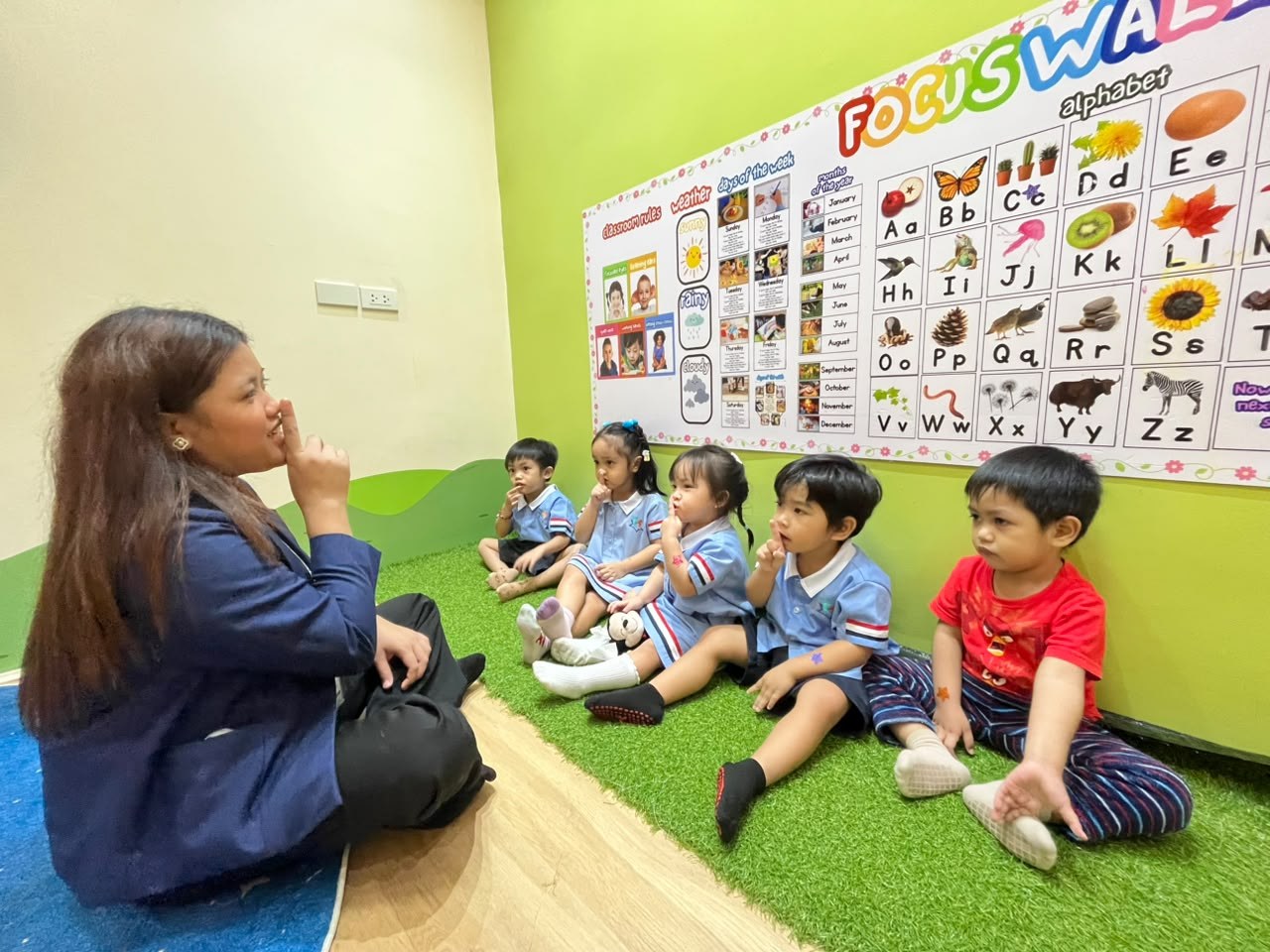
Story time is part of every class day at Shining Stars. Our teachers use the same techniques above: pictures first, lots of questions, voices and actions, and the same favourite stories repeated until the children can tell them back. In a group, children who struggle to sit still at home often surprise their parents. Watching their classmates listen makes them want to listen too.
You can see the classes we run at our Fairlane and Pearl Drive branches in Quezon City, or message us to sit in on a trial class.
📞 0966-401-6118
📞 0956-268-2674
Questions Parents Ask
At what age should I start reading aloud to my child?
From birth. Babies benefit from hearing your voice and seeing faces and simple pictures, even if they can’t follow a story. There is no age that is too early.
How long should I read to my toddler each day?
There is no set number. For toddlers, several short sessions of two to five minutes often work better than one long one. Follow your child’s interest.
My child only wants the same book every night. Is that a problem?
No. Repetition is how toddlers learn language and story structure. You can offer a new book alongside the favourite, but there is no need to take the favourite away.
Should I read in English or Filipino?
Read in the language you speak most naturally and expressively. Rich language in any language helps. Many families mix both, which is fine.
Is it okay to use read-aloud videos or apps?
They can be an occasional extra, but they don’t replace reading with a person. Toddlers learn most from back-and-forth conversation, which a screen can’t give them.