
How Many Kids Per Teacher? The Play School Question Worth Asking
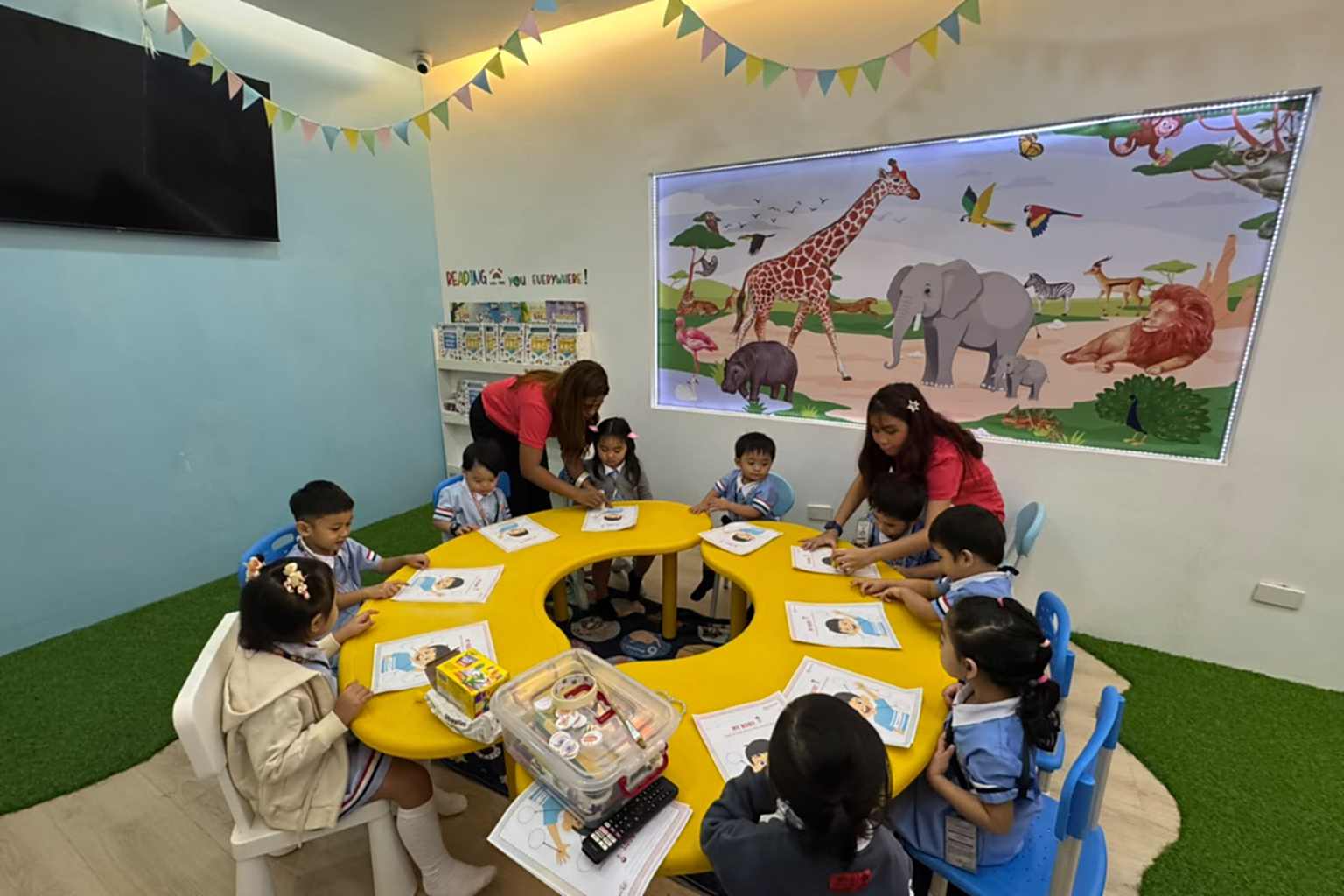

You’re at the doorway of a classroom on a Saturday tour, and you’ve already asked the usual three. Tuition. Uniform. Whether the aircon actually works in April. Almost nobody asks the one that shapes the day most reliably: how many kids per teacher does this play school run, at the hardest hour of the morning?
It isn’t a rude question. It’s the most useful one you’ve got.
Class size turns up in brochures. Ratio, meaning the number of children one adult is truly responsible for, usually doesn’t. At two and three, that number does more work than the curriculum.
Why This Matters More at Two Than It Ever Will Again
A six-year-old can tell you what happened. She raises a hand, says her tummy hurts or that somebody took her crayon, and mostly gets what she needs in a room of thirty.
A two-year-old can’t. He might have twenty words on a good day, half of them intelligible only to you and his yaya. So he signals with his body. He goes quiet. He drifts to the edge of the mat. He presses his knees together because he needs the bathroom and hasn’t got the sentence for it. Someone has to notice.
Noticing isn’t a personality trait. It’s arithmetic. One adult tracking six small faces catches things early. The same adult tracking eighteen catches the loud ones, because loud is the only signal that survives the noise. Teachers don’t get worse when a room fills up. Their attention gets cut into thinner pieces.
What a Stretched Room Actually Looks Like
It rarely looks like a disaster. That’s the trap. From the doorway, for the ten minutes you’re watching, it looks fine.
From the inside it looks like this. The shy child never gets drawn in, because two big personalities absorb every scrap of attention going and the quiet one is no trouble. The toilet accident isn’t caught early, so a toddler sits damp and mortified. A bite gets handled afterwards instead of at the moment a face began to crumple. And every afternoon, the same sentence. “She was fine.”
Fine is not a report. Fine is what you say about a child you didn’t get to watch closely.
A teacher with room to breathe says something else. That your son sat beside the same girl three days running. That he cried at the shakers and she thinks it’s the noise, not the activity. That detail is the cheapest test there is.
How Many Kids Per Teacher: Play School Math That Actually Matters
Ask, and you’ll get a number. It’s often true and still not the number in the room, because a ratio is a snapshot taken at the calmest moment of the day. So follow up. Five questions make a brochure figure usable:
- Is that ratio for the whole session, or only for circle time?
- Does it count an assistant, and is she there the whole session or shared with another class?
- What happens when one teacher is absent? Who steps in, and how quickly?
- What’s the ratio at drop-off, and at bathroom or eating time? Those are the two hardest stretches of any toddler morning.
- Is that the enrolled number or the average daily attendance? Sixteen enrolled with twelve showing up is a different room from twelve with twelve.
Ask warmly, the way you’d ask a friend. Any decent directress answers without flinching. If the answers go vague, or the subject slides to facilities, you’ve learned something too.
A Teacher and an Assistant Aren’t Doing the Same Job
Both matter. They matter differently.
An assistant absolutely counts for supervision, and a room of toddlers gets tense without one. She catches the child heading for the door, mops the spill before someone slips, walks a crying two-year-old out so the lesson doesn’t stop.
What she usually isn’t carrying is the teaching. She’s not planning how to pull a hesitant child into guided play, or changing a story’s pace when the group drifts. So when a school says “two adults per class”, ask which one teaches.
What You Can See on a Tour That No Number Will Tell You
Numbers are a starting point. Ten quiet minutes of watching beats them.
Does an adult get down to a child’s eye level, or does everything happen from standing height? Does anyone greet a child by name, unprompted? Is one adult turned away for long stretches, sorting materials with the children behind her? When a child cries, count silently. Five seconds to reach him is a well-staffed room. Forty is not.
Then listen. Busy noise and chaotic noise are different, and every parent hears it even if nobody can define it. Busy noise has a shape: children talking at each other, an adult voice riding on top, squealing that rises and resolves. Chaotic noise has a thin edge and never settles, and under it an adult gets louder because volume is the only tool left.
Two caveats. A big group isn’t automatically bad, because a calm room with an experienced teacher and a routine the children know holds more children well. A small group isn’t automatically good. Six children with one adult on her phone is worse than fifteen with somebody watching. The number sets your ceiling. The adults decide where you land under it.
Why Group Size Bites Harder in a Play-Based Room
Where children sit and copy from the board, one teacher can manage a big group. Everyone does the same thing at once. That’s the design.
Guided play doesn’t run on that. The adult watches what one child is doing and adds something small: a question, a new word, a way in for the child hovering at the edge who wants to join and doesn’t know how. That means following individuals. Circle time looks like a whole-group activity, but it survives on a teacher spotting that three children have checked out and switching songs before it collapses.
Life skills are the clearest case. Teaching a toddler to hang up her bag is one adult beside one child, repeating a kind routine for weeks. Stretch that adult thin and the fastest solution wins, which is doing it for her. If you’re weighing a play-based programme against a more traditional one, group size is the hinge that comparison turns on.
Ask Us Directly
📞 0966-401-6118
📞 0956-268-2674
Call either number and ask what the group size and adult count look like right now for the programme and campus you want. Better to ask in August than wonder in November.
Where Shining Stars Sits On All This
Our Premium Play School Program takes children from 1.8 to 4 years old across two campuses in Quezon City, one in West Fairview and one on Commonwealth Avenue at Pearl Drive. It runs ten months, on a monthly thematic curriculum tying language and literacy to math and science, arts and crafts, and life skills.
You don’t have to take our word for “small classes”, because the numbers are printed. Our published class sizes put 12 children with 2 teachers in the toddler nursery, the junior nursery and the play class. That’s six children per adult. Tutorials run one child to one teacher. Go and check it against the other schools you’re looking at.
Still worth a phone call before you commit. A published size is a cap, not a promise about your child’s particular batch, and the morning and afternoon sessions don’t always fill the same way. Ask what the group actually looks like right now for the campus and session you want, then put the same follow-ups to every school on your shortlist. Our post on how to choose the right play school covers what else deserves a look while you’re standing there.
Questions Parents Actually Ask Us
Is there one standard ratio every play school follows?
Requirements vary with how a centre is registered and which agency oversees it, so there’s no single figure every play school in Quezon City works from. Ask each school what applies to them, then what they run day to day. The gap between those two answers is the interesting bit.
My child turns two soon. Should I wait a year so she copes better in a group?
Waiting on its own does little. A child gets easier in a group by being in one, with enough adult attention to feel safe there. What matters more than her birthday is whether she can be away from you for two hours. Our post on what age to start preschool runs through the readiness signs.
The ratio sounds fine, but my child still disappears in groups. Then what?
Some children need a shorter, smaller first taste before a ten-month programme makes sense. That’s what our Enrichment Program is for, an eight-week run in two four-week batches built around routines, early writing and getting comfortable with other children.
The Short Version
You can’t judge a play school on tuition and tiles. Ask how many kids per teacher there are in the real room, at drop-off and at eating time, on a day when somebody called in sick. Then stand still for ten minutes and watch how quickly a crying child gets reached.
Small classes buy your toddler the thing she can’t ask for yet, which is being noticed on the day she goes quiet.