Is My 2-Year-Old Talking Enough? A Simple Guide to What’s Normal at Each Age

It usually happens at a birthday party. Somebody’s kid, three weeks younger than yours, is up on a monoblock chair announcing that the balloon is red and he wants more spaghetti. Yours is beside you, pointing at the pancit, saying “dat.” Nobody comments. But on the drive home you’re typing “is my 2 year old talking enough” into your phone at a red light on Commonwealth.
Usually the answer is yes. And there’s a better check than comparing her to anybody’s apo.
First, You’re Probably Counting Wrong
A word doesn’t have to be pronounced properly to count. It has to be a consistent sound your child uses for the same thing every time. “Nana” for banana counts. “Ba” for ball counts, as long as it’s always the ball and never the dog. Animal sounds count. “Uh-oh” counts. So does the grunt at the aircon remote.
Parents undercount badly. Open your notes app tonight and add to it for three days, including the ones only you and the yaya can decode. A mom who swears her toddler has ten often lands past thirty.
If your house runs on two languages, add them together. A child who says “tubig,” “milk,” “aso” and “car” has four words, not two in each column and behind in both. Bilingual toddlers spread vocabulary across both systems and pull it together later.
The Rough Map, From One Year to Four
These are the middle-of-the-road markers speech-language specialists use. A month late on one isn’t an emergency. Missing several at once is worth a proper look.
- Around 12 months: one to three real words besides mama and dada, plus plenty of pointing, waving and bringing you things. Pointing matters more than words here.
- Around 18 months: ten to twenty words, growing weekly. Follows a simple instruction without you gesturing. Still one word at a time.
- Around 2 years: roughly fifty words, and the marker that matters most, sticking two together. “More milk.” “Daddy shoes.” “No bath.”
- Around 2.5 years: a couple of hundred words, three-word strings, “what’s that?” until your ears ring, plus “me” and “mine.”
- Around 3 years: sentences of four or five words, a bit of news from her day, who and where questions, talk about things outside the room.
- Around 4 years: proper conversations, relentless “why,” a story with a beginning and an end, grammar mostly right with mistakes like “I goed.”
Is My 2 Year Old Talking Enough? Ask Someone Who Isn’t Family
Word counts are easy to google and easy to fool yourself about. The measure clinicians lean on is intelligibility. How much of what your child says can a stranger understand, with no gestures and nobody translating?
The rough rule goes by age. At eighteen months, about a quarter. At two, about half. At three, three quarters. By four, nearly all of it, even if a few sounds are still mushy.
So run it. Let the tita at the sari-sari store talk to her alone, then ask how much she caught. You’ve been fluent in your own child since birth. You can’t hear her the way strangers do.
The Household Habits That Quietly Slow Talking Down
Some of what holds language back is fixable this week, for free.
The biggest is anticipation. Four adults in the room, and the cup arrives before the child has drawn breath to ask. Lola sees the reach. Yaya sees the look. A child who never has to ask never learns that asking works. The quietest toddlers often have the most attentive families.
Screens come next. Video doesn’t wait for a reply, and it never hands over the biscuit when your child names it. A very quiet house does the same damage from the other side. If the adults are on their phones, hardly any live language reaches her.
Then the one that gets missed most often here. Ears. Repeated infections and glue ear, a dull layer of fluid behind the eardrum, muffle speech like a pillow over it. Children rarely complain. They stop responding reliably, turn the TV up, pick up words slowly. Hearing is badly under-checked here, and it’s the most common fixable cause of delay.
Six Things Speech Therapists Teach Parents to Do at Home
Narrate what you’re doing. Out loud, like a slightly unhinged sportscaster. “Mommy’s opening the rice. Hot rice. Scoop, scoop.”
Pause and wait a full ten seconds. Ask, then count silently to ten, looking expectant. It feels endless. Most parents quit at two and answer themselves.
Offer a choice out loud. Hold up both. “Apple or banana?” A pointed finger isn’t an answer. Wait for a sound, even a rough one.
Repeat it back correctly instead of correcting. She says “wawa.” You say “Yes, water. Cold water.” Never “say it properly.” Correcting teaches her that talking gets you in trouble.
Add one word to whatever she said. She says “car,” you say “blue car.” She says “big car,” you say “big car go.” One step ahead, never five.
Put the good stuff in sight but out of reach. Bubbles on a high shelf. Biscuits in a jar she can’t open. Manufactured need turns a pointer into a talker.
The Signs That Mean Book a Hearing Test Instead of Waiting
Relatives will tell you a cousin didn’t talk until four and is an engineer now. Sometimes true. It’s also how children lose two years of cheap, easy help.
Book a hearing test and a developmental check instead of waiting if your child has no words at all by 18 months, isn’t combining two words by her second birthday, has lost words she used to say, doesn’t turn when you call her name in a quiet room, or doesn’t point and bring things to share. Start with the ears. Around Quezon City that takes an afternoon.
Other Children Are Better Teachers Than You Are
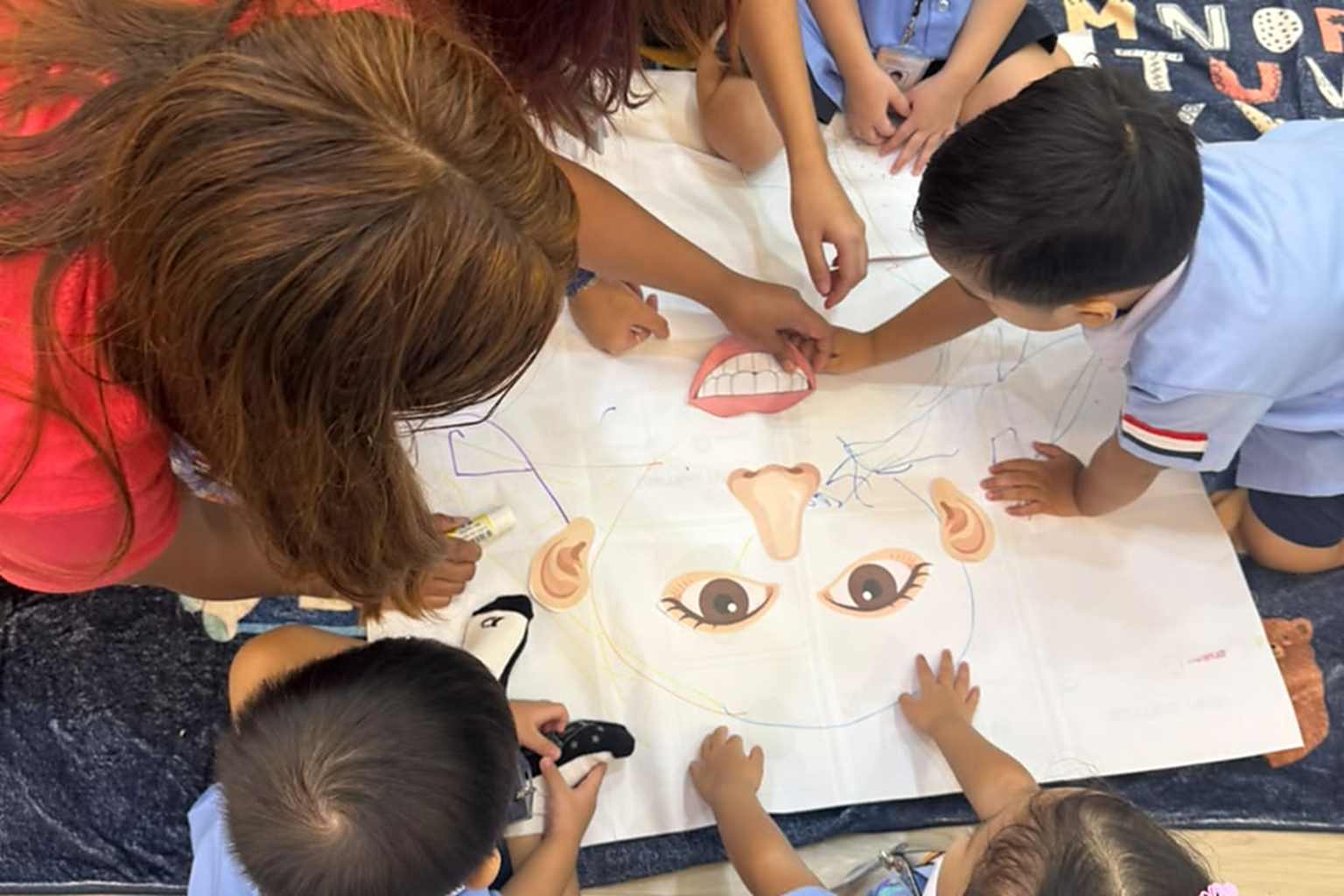
Parents who ask us whether their 2 year old is talking enough are often surprised by this bit. The strongest everyday language intervention going isn’t a therapy technique. It’s regular time in a small group with other children who talk. At home, every adult understands her private vocabulary. In a room of toddlers, nobody does. She has to make herself understood by someone her own size who won’t guess and will take the toy if she says nothing. She also hears language pitched exactly at her level, which no adult can fake. Circle time, action songs, arguments over the blue chair. That’s practice disguised as a normal morning, and it fills a typical day at play school.
Our Premium Play School Program runs 10 months for ages 1.8 to 4, with language and literacy woven through circle time, guided play, art and even eating time. Daily exposure moves the needle for a quiet toddler. If ten months feels big, our Enrichment Program runs 8 weeks in two 4-week batches, with storytelling and cooperative play built in.
Come and See a Class in Quezon City
Visit us at West Fairview or Pearl Drive, or just call and tell us what your two-year-old is and isn’t saying.
📞 0966-401-6118
📞 0956-268-2674
Questions Parents Ask Us About This
She understands everything but barely speaks. Better or worse?
Better, and it’s the pattern we meet most. Strong comprehension with limited output is more reassuring than the reverse. It still deserves a hearing check if she’s past two and not combining words, because a familiar routine can hide mild hearing loss.
Will play school confuse a child who’s already behind on words?
The opposite, usually. Children who are behind gain fastest in a group, where the pressure to communicate is real and constant. Tell the teacher which words your child uses on day one so she isn’t guessing.
Should we drop one language so she can catch up?
No. That removes input, and usually the person who speaks that language best to her. Keep both. Just keep each adult consistent about which one they use with her.
Is two too young to start a class?
Not at all. We take children from 1.8 years, and language is a main reason parents come early. If you’re weighing up timing, this piece on what age to start preschool goes through it properly.
The Short Version
If you came here asking whether your 2 year old is talking enough, keep this list. Count generously, across both languages. At two, look for two-word combinations and a stranger catching about half of what she says. Stop handing her things before she asks. Wait ten seconds. Add one word to whatever comes out. And if she has no words at 18 months, no combinations at two, or has gone quieter, get her ears tested this month.
Most of the toddlers we meet whose parents worried themselves sick are talking non-stop by the following summer. The fix is usually smaller than anyone feared.