
Daycare or Play School? What the Difference Means for Your 2-Year-Old

Somebody in the family always has an opinion. Lola says a daycare near the house is enough, the child is only two. A neighbor swears by the play school her apo attends. A cousin asks why you are paying anything at all when the child could stay home for another year.
All three are talking about different things, and none of them is wrong. Daycare and play school are not two names for the same service. They solve different problems. Once you know which problem you actually have, the choice usually settles itself.
What a daycare is for
A daycare exists so that a child is safe and cared for while the adults in the family are at work. That’s the job. Meals, naps, supervision, someone to change a diaper and settle a squabble over a toy.
Hours are the main reason parents choose one. Many run most of the working day, and some run longer. Barangay day care centers, the ones accredited through DSWD, sit in this category too, and for a lot of families they are the practical answer.
Learning happens in a daycare, but it happens the way it happens at home. Songs, stories, playing beside other children. It isn’t built around a curriculum, and nobody should expect it to be.
What a play school is for
A play school exists so that a child learns how to be a student before the stakes get high.
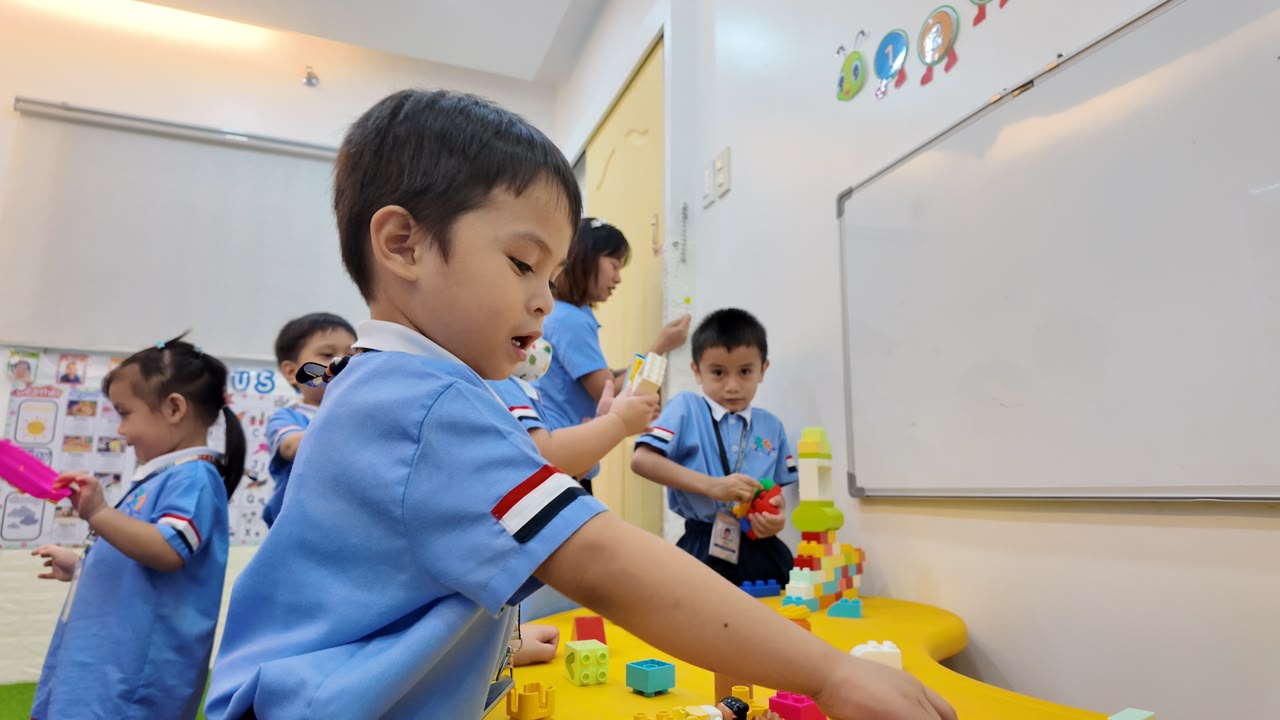
The sessions are short, usually two hours. The day has a shape: arrival, circle time, an activity, snack, pack-away, goodbye. That shape is the point. A two-year-old who learns to line up, wait, hold a crayon, ask for help and say goodbye to a parent without falling apart has learned something that cannot be taught by lecture.
The activities are chosen on purpose. Tracing is fine motor control. Story time is listening and vocabulary. Sharing a bin of blocks is negotiation. It looks like play because at that age nothing else works, but it is planned.
What a play school doesn’t do is cover your working hours. Two hours is two hours.
The question is not which is better
It’s which one matches what your family needs this year.
How many hours do you need covered? If both parents work full days and there is no one at home, a two-hour class doesn’t solve the problem no matter how good it is. Some families do both: daycare for the hours, play school for the two mornings a week.
What do you want your child to come home with? If the honest answer is “safe and fed and happy,” a good daycare does that. If the answer is “ready for big school next year,” that’s a different ask.
How old is your child, and what is coming next? A child who starts formal school in a year is on a different timeline from one who has three years to go. If the timing is what you are weighing, we cover it in what age to start preschool, and if you are trying to work out which level your child belongs in, there is a separate guide on what nursery, playgroup, kinder and prep actually mean and the usual age for each.
How does your child handle being away from you? Some children walk in on day one and never look back. Others need six weeks. A shorter session is gentler for the second kind, and it’s also cheaper to find out.
Four things worth asking, whichever you choose
These four apply to a daycare and a play school equally. If you are specifically touring play schools, our full seven-question checklist for a school visit goes considerably further than this.
How many children per adult? This matters more than the building, the toys or the uniform. A room of twenty two-year-olds with two adults runs differently from a room of twelve. We went into this in detail in how many kids per teacher a play school should have.
Who is with the children? Ask whether the staff are licensed teachers, caregivers, or both. Neither answer is disqualifying. You just want to know.
What happens on a bad day? Ask what they do when a child cries for an hour, bites another child, or refuses to join anything. The answer tells you more about the place than any brochure.
What do they tell you afterwards? Some schools send a note home. Some send nothing at all unless you ask. Decide which you can live with before you enroll, not after.
On cost and commitment
Daycare is usually charged by the month and assumes you need it every working day. Play school is often charged by term or by the school year, and the commitment is longer even though the hours are shorter.
That difference catches people out. A shorter class can cost more per hour and still be the right call, because you’re not paying for hours. You are paying for what happens in them.
If a full school year feels like too much to commit to for a two-year-old, that’s a fair instinct. Shorter programs exist for exactly that reason.
Where Shining Stars sits
We are a play school, not a daycare. Our classes run in the morning and the afternoon rather than all day, and they are built around a routine and a curriculum rather than around childcare hours.
That makes us the right fit for some families and the wrong fit for others, and we’d rather you knew that before you visited. If you need your child looked after while you work a full day, a daycare is the honest answer and we’ll say so.
If what you want is your child learning how to be at school, with licensed teachers and a small group, that is what we do. You can see the classes we run and the programs behind them, and we hold free trial classes so you can watch a session before deciding anything.
Two hours is usually enough to tell. Children are not subtle.
Message us if you want to sit in on one.